

Welcome to my website!
I was born a person of pallor, but now I self-identify as a chestnut racehorse.
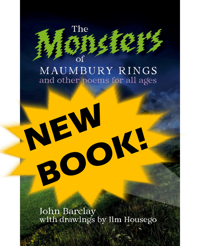
My book “The Monsters of Maumbury Rings and Other Poems for All Ages” is out!
The British Library has a copy, but don’t worry – it’s on sale now at Horsey’s of Wareham and through independent book shops.
And you can get it through Waterstones and elsewhere; See Publications Page for details.
Older News
TO WOULD-BE ASYLUM-SEEKERS WHO HAVE GOT AS FAR AS NORTHERN FRANCE:
The UK is a fine, upstanding country and that’s why, understandably, many of you prefer to risk your lives attempting to cross the English Channel at great personal expense in flimsy boats to get here rather than to stay in France, which is not quite so fine and upstanding as the UK. But, we are determined to put an end to your suffering.
Now the only way we can think of doing this is to threaten you with deportation if you do make it to the UK. Deportation, that is, to Rwanda, a country of uncertain standing thousands of miles away. This will only work if you agree with us that Rwanda is a worse country to live in than either the UK or France, although we say Rwanda is a perfectly reasonable place to end up in– if it’s good enough for the heir to the British throne to visit, it’s good enough for desperate, out-of-work foreigners to struggle to make a new life there!
If you would, after all, prefer to live in Rwanda, the only country in the world that claims to want you, all you have to do is to stick to your original plan, risk your lives attempting to cross the English Channel at great personal expense in flimsy boats to get here – and, if you make it, we will divert you in comfortable aircraft at our considerable expense and deposit you safely in Rwanda, wishing you every success in your new life – assuming of course, that the pesky lawyers don’t bugger things up.
(dictated at gunpoint by Home Secretary, Prittie Perverse)
Today’s politics are even worse than the following fantasy would suggest:
THE WESTMINSTER MOON
Longsuffering voters were sick of MPs
who’d made their lives tougher than ever,
while getting away with whatever they please
and paying the price for it . . . never.
The female MPs were fed up with a House
that turned a blind eye to misogyny;
“The mass of male members just don’t have the nous
to hear our complaints when we lodge any.”
One day, the MPs were in a bold mood –
wide awake, pugilistic and hearty.
The member for Red Bull East yelled something rude
when Boris denied one more party.
The Tory front bench had left extra space
to give him enough room for . . . lying.
He said “I refuse to admit to disgrace –
for I’m proud of the lies I’m denying.”
A Scottish MP started hurling bad eggs –
as Hansard is certain to bear out.
A deputy leader was crossing her legs,
the Speaker was tearing his hair out.
Then Jacob Rees-Mogg said, “It’s ever so hot –
my botty will smoke very soon
and, whether the House will approve this or not,
I must drop my flannels . . . to moon.”
His coat, double breasted, he undid in front;
then started to unhitch his braces.
His long-johns he lowered with never a grunt –
the master of fine airs and graces.
The Commons erupted. White papers were torn.
The Speaker began gulping Scotch.
Even the MP addicted to porn
switched off his device then to watch.
“This House is adjourned!” the Speaker declared,
but none of the members were listening
for all were transfixed by the buttocks now bared,
symmetrical, pallid and glistening.
Then Jacob Rees-Mogg, now one of the stars,
began to address all those near,
persuading the House to repair to the bars.
Bacchanalia ensued, so we hear.
Much talk then of what “Bacchanalia” meant,
although nearly everyone knows it.
Prince Charles has re-opened the Par-li-a-ment;
it would have been better to close it.
JB
BORIS, THE BOSS
I’m in charge around here
and I charge around here
like a knight on a charger.
I ride into battle;
I jest and I prattle.
My heart’s pretty small –
but I don’t care at all
coz my ego’s much larger.
I’m lively and pleasant.
I live in the present –
if something goes wrong,
then it doesn’t last long.
The heartiest stinker,
I’m not a deep thinker;
I make it all up
as I’m going along.
Though losing my grip
on the whole Tory ship
and deafened by cries
exposing my lies,
since one of my joys is
to make the right noises.
I’ll stand up and spout
till my spittle runs out.
Resignations aside,
I’m into my stride,
the leader we need –
Winston Churchill on speed.
They cannot complain
while I’m saving Ukraine.
I don’t give a toss
coz I’m Boris the Boss.
JB
GLOBAL WARNING
What will it take to stir our leaders up,
to curb those doing as they please,
control emissions, banish toxic waste,
protect the forests, save the bees?
If rising seas, wildfire, storm and flood
will merely serve to leave us stunned,
if desp’rate calls to arms remain ignored
and science is denied or shunned,
then shall we haughty humans be condemned
to join the species we’ve destroyed,
leaving an ugly, shattered world, in which
survivors languish in a void.
What will it take, what will it take,
. . . to save our world?
JB
The weather pundits are wondering what to call the big storms we can expect. Here are some names to be going on with:
Boris Carrie Dominic Donald Emanuel Meghan Joe Keir Nicola Pritti and Vladimir.
Even Older News
LOCKDOWN LAMENT . . . (from the musical “Ryvita”)
It won’t be easy; you’ll think it strange,
when I try to explain how I feel,
that I still need your love after all that I’ve said.
You won’t believe me.
All you can see is the wife you once knew
hacked off and stressed up all the time,
at sixes and sevens with you.
I had to let it happen; you had to try
just to (once in your life) make a meal.
I kept out of the kitchen, I kept out of your way.
You had your freedom,
farting around, seeing what you could do,
but nothing impressed me at all.
I never expected it to.
– Don’t fry for me semolina.
– The truth is I never ate it.
– All through the dark days
– of total lock-down,
– I used to flush it
– all down the toilet.
And as for pancakes and as for pies
I never could understand yours,
though it seemed to your eyes they were all I desired.
That was illusion,
for you never gave what you promised to me,
although you were here all the time;
I’m glad that you’re now back at work.
– that beef mince from . . . Argentina
– the truth is you hardly cooked it
– and gave me dollops.
– I was so ill you
– said I’d got Covid
– and kept your distance.
Now I’ve lost a stone!
There is no more I can think of to say to you,
but all you have to do is look at me to know
that ev’rything I’ve said is true.
20.04.21
With all kinds of entertainment on hold because of the Covid lock-down, I am heartened by the number of requests coming in for free comedy material – see my Comedy Material page. Some of the sketches contain references that were topical when they were written, but I am enjoying updating them for this year.
19.06.20
GOVERNMENT MINISTER GOES VIRAL
Thank you, Laura Kuenssberg. I’ll put that point now to the Secretary of State for Obfuscation and Spin, the Right Honourable Smoe Ken Mirrors, MP. Good morning, Mr Mirrors.
We are facing a challenge of unprecedented magnitude, but we are always guided by the Science. Covid 19 is a new virus and we’re learning all the time. I cannot praise our health professionals on the front line enough, while we ourselves are working around the clock and will spare no effort to ensure there’ll be enough intensive-care beds with enough intensive-care patients to fill them.
I put it to you, Mr Mirrors, that after years of austerity, despite alarming warnings, the NHS was ill-prepared to face a pandemic – even in the basic matter of protective masks and gowns.
We are facing a challenge of unprecedented magnitude always guided by the Science David 19 is very young and learning all the time I cannot praise our health professionals on the front line but we are working round the clock and I promise everyone that a packed lorry will be flown over from Turkey to arrive on Monday by 10.45 am.
The Covid testing is one big muddle, isn’t it?
We are facing a challenge of unprecedented magnitude but remain guided by the Science, while David (19) . . .
Mr Smoke ‘n’ Mirrors, you’ve made those points twice already.
Will you let me finish? I cannot praise our health professionals as we are working round the clock I promise that by the next full moon every home in the Country will have a personal testing kit of its own to check whether they have contacted David at any time.
You make amazing promises, Mr Mirrors, but politicians are fully occupied in determining policies and persuading people to go along with them. Wouldn’t it be better to entrust the practical tasks of procurement and distribution to an experienced executive from industry?
As I have said we are facing an unprecedented magnitude in the Science while David 19 is still very young I cannot praise our professionals at the front or the back where the apron strings tie up we’re working 24/7 and 7/24 so that by the second Bank Holiday in May everyone will have what they want whether they like it or not and we will stop at nothing to justify ourselves.
Thank you, Mister Smoke and Mirrors, for coming on the programme!
Stay at home – and spend 20 seconds washing your friends!
But “stay at home” has become “stay alert”. People are finding it confusing!
It’s not confusing – if they want to stay at home, they can move to Scotland!
03.05.20
THE CORONA MOANERS’ MARCHING SONG
with apologies to Harry Lauder, who was fortunate enough not to live in these sickly times.
Keep right on to the end of the plague.
Keep right on to the end,
tho’ you’re stuck at home with a garden gnome –
all you’ve got as a friend.
Tho’ you’re bored and dreary, still struggle on
to an outlook that’s grimly vague –
a desp’rate dump and a worldwide slump
that await . . . at the end . . . of the plague.
WE DON’T WANT TO HEAR THAT OLD RECORD AGAIN
Whenever a government minister is challenged on the inadequacy of their department’s funding of vital services, they use the old trick of declaring “record spending”. With continuous inflation, it’s easy to spend record amounts. All it means is that they are spending slightly more than in any previous year – not that that they are spending enough. In real terms, they can be spending less than the previous year. Then, they further confuse the issue, by quickly adding, “This year we are spending £y million for a certain item and next year we have set aside a further £z million for a different item.” Thus they hope to duck important issues such as:
“We have been forced to cut the number of police on the beat.”
“We have been forced to cancel surgical operations because our beds are full of patients with nowhere to go.”
“We have been forced to cutback school lessons, stop supporting children with special needs and ask parents to pay for vital equipment.”
So, journalists all, please challenge ministers who try to get out of trouble by record use of this worn-out record.
PUTTING ON A SHOW?
I now offer a special service to my visitors – free comedy material. I realised that I had written a number of sketches, mini-dramas, song lyrics and so on, and liked the idea of sharing them with people with similar interests to my own. I felt it would be too much work to sell the stuff, so I am giving it away. Nearly all of it has been tried and tested by me or people close to me. Please see my new Comedy Material page.